For those not familiar with Q methodology, it is a method for objectively measuring a person's subjective reactions to anything from images to phrases such as slogans. It was developed by William Stephenson, a psychologist, beginning in the 1930s. He worked for a time in advertising, and was looking for a way to identify the most effective slogans for companies. His method was simple: Each participant was given a set of cards with different slogans, and told to arrange them on a grid according to preference, with the most preferred to the right and the least to the left. His grid was drawn on a large sheet of paper. What a typical grid looks like:
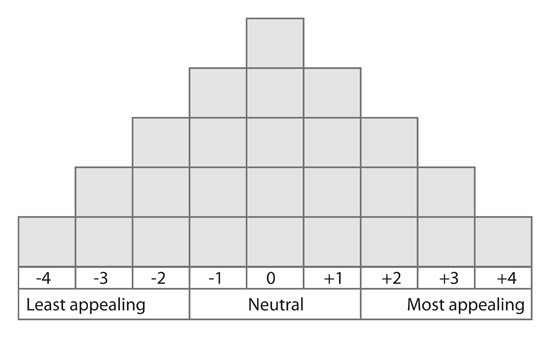
The grid has numbered columns, allowing each selection to be scored.
Stephenson described the method as an inversion of conventional factor analysis: Instead of a large number of people being given a small number of choices, a small number of people are given a large number of choices.
The number of items to be sorted, called the Q set, can vary but typically is anywhere from 12 to 52. The number of people being tested is called the P set, and is usually smaller than the Q set. Stephenson claimed that he could identify common preferences with as few as half a dozen participants.
There is growing interest in Q Methodology in the academic community. There are numerous books and articles on the subject, and even conferences devoted to it.